

The Rev’d Ivica Gregurec
Ascension Day, 17 May 2026
Readings: Acts 1:1–11; Psalm 47; Ephesians 1:15–23; Luke 24:44–53
The disciples stood there, gazing up into the sky. Two men in white (disciples?, angels?) had to nudge them back to earth: ‘Why do you stand looking up toward heaven’? It is one of the most human moments in the whole of scripture. Something extraordinary had happened that could not yet be named, and their instinct was simply to stare upward, as if the answer might still be visible if they looked long enough.
I think we know that feeling. We stand at gravesides, at thresholds, at the end of chapters we did not choose to close, and we look up, or inward, or outward, for some remaining trace of what has passed. The Ascension begins, in other words, not in the heavens, but in that very human posture of longing and bewilderment.
So, let us pause here, before we rush to doctrine or to doxology, and ask the honest question that serious, thoughtful people ask today: what actually happened on that hillside outside Jerusalem, at the Mount of Olives? Can we hold both scientific integrity and spiritual truth in the same hands without one crushing the other – as, at least in my head, in this report about Ascension my faith and my cosmology clash in a fairly direct way?
The cosmology of the first century was clear, if we may call it that. The earth was the centre. Above it, layered like the floors of a great palace, were the heavens: first the sky, then the stars, then the firmament, and at the very summit, the dwelling place of God. To ascend into heaven was not metaphor, as it was literal geography. Our first hymn today (thank you Charles Wesley), though written in 18th century reflects exactly that layered, almost as a Russian honey cake, world: ‘Hail the day that sees Christ rise, to the throne above the skies’.
Jesus, the disciples believed, had been taken upward through those layers, to be installed at the right hand of the Father.
I do not know about you, but I cannot share that cosmology honestly. We know that ‘up’ from Jerusalem leads to the International Space Station and then to a void of incomprehensible scale, deep some 13,8 billion of years. There is no throne room above the clouds. And yet, to say this is not to dismiss the Ascension, but it is to begin understanding what the Ascension was actually pointing toward, which was never, at its heart, a matter of altitude.
Consider what the gospel and Acts of the apostles together try to communicate. Luke tells us that after the resurrection, Jesus was present among the disciples in teaching, breaking bread, and opening their minds to the scriptures. But this presence was different. Doors did not stop him as he appeared and withdrew. It was real, and it was strange. The resurrection narratives strain against ordinary language because they are describing something at the very edge of what human experience can contain.
The Ascension, then, is the moment when this liminal, transitional mode of presence ends and something shifts. The disciples can no longer expect to find Jesus on a road to Emmaus or at a lakeside breakfast. What Luke is narrating is a transformation in the mode of Christ’s relationship to the world. Namely, the cloud that receives Jesus is a detail with deep roots in the Jewish theology of divine presence, the Shekinah glory, not a meteorological report. He does not simply leave. He enters a new kind of universal availability.
Paul, writing to the Ephesians, grasps this with startling clarity. He prays that they might know the immeasurable greatness of the power at work, that Christ has been raised and seated ‘far above all rule and authority and power and dominion’. This is not spatial language in any literal sense. It is the language of sovereignty, of scope. The ascended Christ is not somewhere else. The ascended Christ is, to use a phrase that stretches grammar almost to breaking, everywhere else.
Before the Ascension, Jesus was present in one place at a time. After it, as the Spirit is poured out at Pentecost, Christ becomes present in every gathering, every breaking of bread, every act of mercy and justice done in his name. The Ascension is not the story of Jesus going away. It is the story of Jesus becoming free from the constraints of singular location, so that he might be, as Paul puts it, ‘filling all things’.
This is something a scientific age can, with a little patience, begin to understand. We are not being asked to believe that Jesus flew through the stratosphere or exosphere. We are being invited into a different kind of claim entirely: that at a particular moment in history, the life of this particular human being crossed a threshold that changed the structure of reality; that the love and wisdom and self-giving that was concentrated in him was released, like light through a prism, into the whole fabric of existence – thank you Pink Floyd for a vivid contemporary pop icon (front cover for ‘The dark side of the moon’ album).
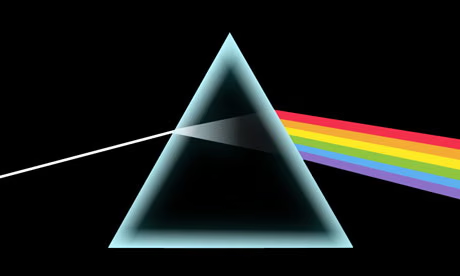
Whether you find that claim credible will depend, in the end, not on astronomy but on your experience of prayer, of community, of those moments when something larger than yourself seems to breathe through an ordinary day. Our faith tradition has always trusted that reason and faith are not enemies but conversation partners. We do not ask you to leave your mind at the door, but we do ask you to consider whether the door is the only way in.
Psalm 47, which we prayed today, was originally a coronation hymn. ‘God has gone up with a shout, the Lord with the sound of a trumpet’. It was sung to celebrate a victory, an enthronement, the installation of a king who would bring justice and peace. The early church borrowed it and heard in it the voice of the cosmos welcoming its true Lord. He is not a tyrant going to his throne, but a servant-king, one who washed feet and died between criminals, now vindicated and honoured.
This is the political claim embedded in the Ascension that we often overlook. We have come to understand about the importance of the inclusive language. Using only one gendered-based image of God is not helpful and we try to use diverse images when we talk about God. I do get that and it is important. Nevertheless, if those attempts are non-historic, they will often dismiss calling God or Christ Lord. Apart from being a patriarchal title, for many it goes back only until medieval England where lords were lords and peasants were peasants.
But to say ‘Christ is Lord’ in the first century was to say, implicitly, that Caesar is not Lord. The Ascension was a subversive act of theological naming: this is who is ultimately in charge, and it is not the powerful, the violent, or the wealthy. It is the one who gave himself away. Every Ascension Day, we renew that quiet, radical allegiance.
Luke ends his gospel with the disciples returning to Jerusalem with great joy. Not grief, but joy. They had watched their Lord taken from their sight, and yet they were not desolate. They went to the temple and blessed God. Something in that farewell had given them not emptiness but fullness, not an ending but a commission. ‘You are witnesses of these things’, Jesus had said. Now they were to wait for the power to be that witness.
We are the inheritors of that witness. We live in the long Ascensiontide of history, between the departure and the final coming, between the promise and its fulfilment, between that wonderful theological ‘already and not yet (iam et nondum)’. It is an in-between time, and it can feel like absence. But the tradition invites us to understand it as a different kind of presence: the presence of a Spirit poured out without limit, available to every seeking heart, in every culture, in every century.
So do not stand gazing up into the sky. Look around you. The commission is here. The need is here. The ascended, liberated, boundary-crossing Christ is here: in this bread and this cup, in this community, in the face of the stranger, in the beauty that catches you and will not let you go.
This is what Ascension means, if we let it. Not the disappearance of the sacred, but its expansion; not the end of the story, but the beginning of our part in it.
Finally…at the traditional place of Jesus’ ascension at the Mount of Olives, today stands an ancient mosque, built on the ruins of an older Byzantine church. It is a place of pilgrimage and devotion, not only for Christians, but also for Muslims, who have protected that space for centuries. It is a call to all of us to see that in post-Ascension world, Christ’s presence can be seen even there, where sometimes we do not expect it. It might be a call to build the bridges of mutual understanding in the world God loved and loves so much. Amen.