
The Rev’d Ivica Gregurec
Maundy Thursday
Readings: Exodus 12:1-14, Psalm 116:1-2,11-18, 1 Corinthians 11:23-26,
John 13:1-17,31b-35
E te whānau,
Tonight, as we move toward the quieting of autumn, as the nights grow a little longer and the hints of cooler air remind us that the world is turning and we gather around a table. We gather, as communities have gathered for two thousand years, to remember a night that changed everything.
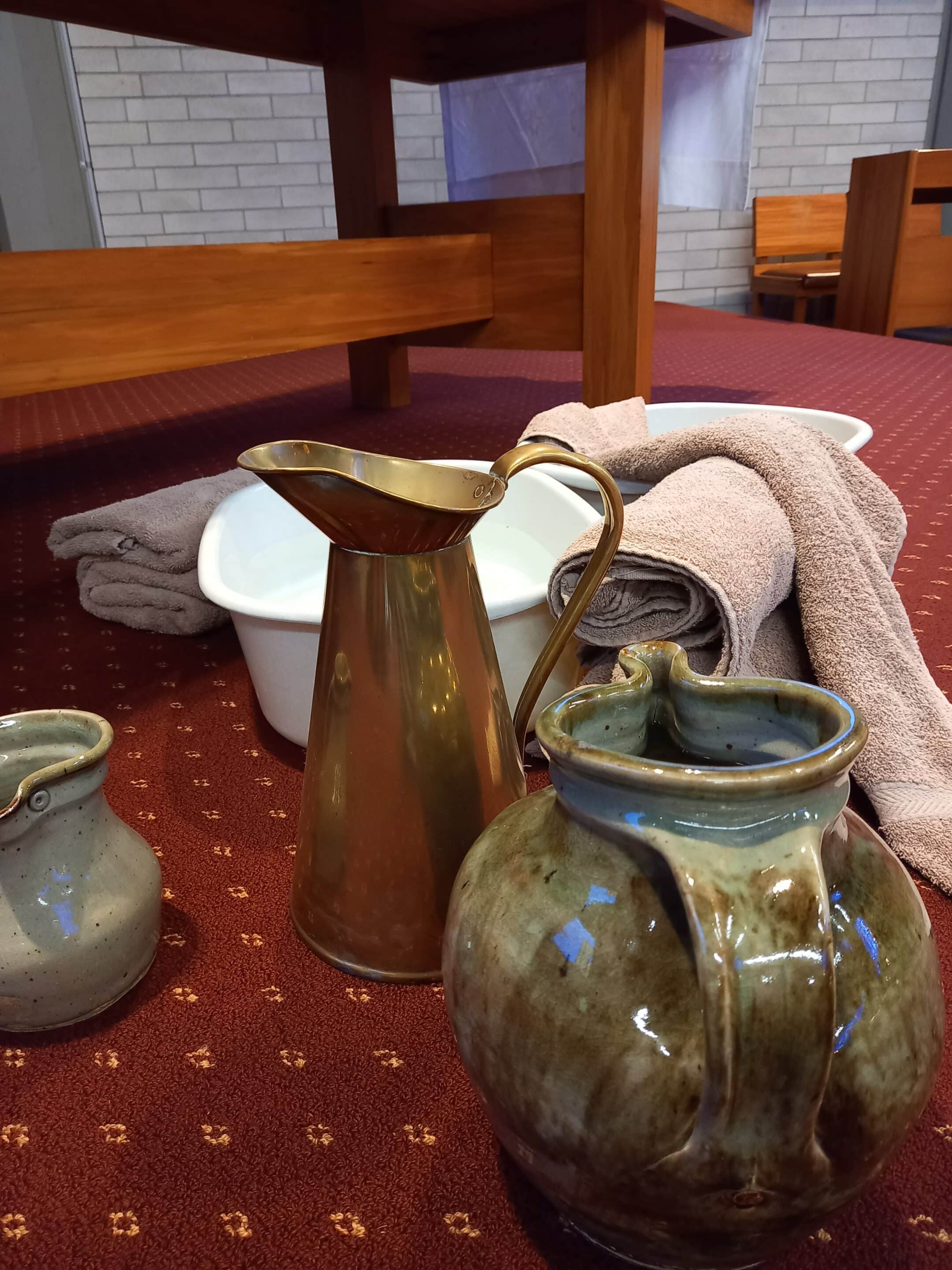
It is night in Jerusalem. The Passover moon hangs heavy over the city. In an upper room, a teacher and his friends are at supper. And Jesus, John tells us, knowing that his hour has come; knowing that he had come from God and was going to God, rises from the table, takes off his outer robe, ties a towel around himself, pours water into a basin, and begins to wash his disciples’ feet.
Let us sit with that image for a moment. Here is the one whom the Church confesses as Lord of all creation who is stooping down, taking the dust-caked feet of his friends into his hands, and washing them. One by one.
‘Do you know what I have done to you? You call me Teacher and Lord – and you are right, for that is what I am. So if I, your Lord and Teacher, have washed your feet, you also ought to wash one another’s feet’ (John 13:12–14).
Tertullian (c. 155 – c. 220, modern day Tunisia), writing in the early third century, saw in this gesture the very shape of the Gospel made flesh: that authority, in the kingdom Jesus inaugurates, is not grasped but given away. Service is not the means to power, but the power itself. And St Augustine of Hippo (354 – 430, modern day Algeria), reflecting on this passage, wrote that Christ washes the feet not merely as an example of humility but as a sign of his continual cleansing work in us, that we are, even now, being washed, made clean, drawn deeper into the mystery of his love.
In Aotearoa, we know something of this kind of servant leadership through te ao Māori. The concept of manaakitanga, of caring for others, of lifting the dignity and wellbeing of the people around you, resonates deeply with what Jesus does in this upper room. Hospitality, in te reo and tikanga, is not merely a social courtesy; it is a sacred act, an expression of who we are in relation to one another. Tino rangatiratanga, true chiefly authority, is never exercised at the expense of others; it is expressed in service, in aroha, in the genuine regard for the mana of every person present.
When Jesus wraps that towel around himself, he is not diminishing himself. He is showing us what true greatness looks like. This is the God who stoops and kneels.
Then, as if the washing were not enough, Jesus takes bread.
Saint Paul, writing to the church in Corinth, perhaps twenty years before the Gospel of John was even composed, hands on what he himself had received: a tradition older even than his own words. Listen to it again, for we have perhaps heard it so many times that we risk no longer hearing it:
‘The Lord Jesus on the night when he was betrayed took a loaf of bread, and when he had given thanks, he broke it and said, ‘This is my body that is for you. Do this in remembrance of me.’ In the same way he took the cup also, after supper, saying, ‘This cup is the new covenant in my blood. Do this, as often as you drink it, in remembrance of me’’ (1 Corinthians 11:23–25).
On this night – of all nights – we are called to hear those words freshly, as the first hearers heard them. The broken bread. The poured cup. The extraordinary claim that in this ordinary sharing, the Lord himself is present.
St Cyril of Jerusalem (313 – 386, Palestine), in his ‘Mystagogical Catecheses’, writes to the newly baptised with breath-taking directness: do not think of the bread and wine as mere bread and wine, he says, they are the Body and Blood of Christ, as the Lord himself has declared. And across our broad Anglican tradition, we share in common the conviction that this meal is more than symbol, we believe in Real Presence of Jesus in it. But we live with mystery – we do not need to define it to smallest detail. Something happens here. Something is given. Someone is given.
Former Presiding Bishop of the Episcopal Church in USA, Michael Curry (b. 1953, USA), once described the Eucharist as “love made tangible.” That seems right. In the same way that Jesus’ hands touched the dirty feet of his disciples, his hands now touch ordinary bread and ordinary wine and they become the vehicle of extraordinary grace.
Washing feet and breaking bread. These two gestures belong together on this night and they are, in a deep sense, one act.
When feet are washed, we enact what the Eucharist makes possible: a community ordered not by rank or status or achievement, but by mutual self-giving. When we gather at the Lord’s Table, we are fed for exactly that kind of life, the life of the towel and the basin.
There is a beautiful passage in the Didache (1st century AD) – that earliest of Christian documents, perhaps as old as any of the Gospels, which describes the Eucharistic bread as the gathered grain of many fields, brought together into one loaf. The community that breaks this bread is called to be what the bread is: many different people, many different gifts, many different stories – including, in this land, the stories of Māori and Pākehā, of Pacific peoples, of Asian and African and European heritages – brought together into one body.
Tonight, in Aotearoa, we gather in autumn’s approach, in a season of harvest, of fruit, of things being gathered in. It is a fitting time to receive the gifts of this holy night. The wheat has been gathered and the grape has been crushed. The bread is broken and the cup is poured. And we, all diverse, imperfect, and beloved, are invited to the table.
Before we close, we cannot pass by the words Jesus speaks after the washing:
‘I give you a new commandment, that you love one another. Just as I have loved you, you also should love one another. By this everyone will know that you are my disciples, if you have love for one another’ (John 13:34–35).
The Greek word John uses for “new” here is καινός (kainos) – not simply recent in time, but qualitatively new, renewed, transformed. This is not just another rule to add to the list. This is the principle from which everything else flows.
Love one another as I have loved you: not as an equal exchange, not as a contractual obligation, but with the self-giving, kneeling, basin-and-towel love that Jesus has just enacted before their eyes.
St Irenaeus of Lyons (c. 130 – 202, modern France) wrote in the second century that ‘the glory of God is a human being fully alive’. On this night, Jesus shows us what that full aliveness looks like: it looks like love in action. It looks like service. It looks like bread broken and shared. It looks like a basin of water and a towel.
Shortly, we will do what Christians have done on this night for centuries: I will wash your feet, which is an act of vulnerability, of trust, of sacramental solidarity. And then we will gather at the Lord’s Table, and we will receive once more the gift that was given ‘on the night of his betrayal’.
Notice that phrase: on the night of his betrayal. Not in spite of betrayal, but in the middle of it. Jesus knew that one of those whose feet he had washed would betray him before morning and he washed his feet anyway. He gave him bread and wine anyway. That is the kind of love we are talking about, which we are called to embody.
We leave this service tonight in silence, as tradition bids us: stripping the altar, watching, waiting. The joy of Easter is coming, but we are not there yet. Tonight, we stay in the upper room. Tonight, we receive the gift. Tonight, we let this love wash over us and then go out to offer it in our families, our communities, our nation, as grace poured out, bread broken, feet washed.
Go gently, dear friends. The night is not over.
But the love is already here.
Amen.
PATRISTIC READING
Tertullian (On Prayer)
St Augustine of Hyppo (Tractates on John)
St Cyril of Jerusalem (Mystagogical Catecheses)
St Irenaeus of Lyons (Against Heresies)
Didache (1st cent.)
TE REO MĀORI TERMS USED
manaakitanga (hospitality/care for others)
tino rangatiratanga (chiefly authority/sovereignty)
te ao Māori (the Māori worldview)
aroha (love/compassion)
mana (dignity/authority/prestige)