
Rev’d Jacky Sewell
The Last Week of Creationtide and The Feast of St Francis of Assisi
Readings: The Song of Three, Galatans 6:14-18, Matthew 11:25-30
The trouble with being a passionate gardener and lover of creation is that some things have to die, in order that other things might find life.
Since I’ve lived in my present home here in Howick I’ve been transforming my patch of God’s green earth into what I hope is a bird’s paradise and at last count there were five different species native birds regularly visiting and nesting, alongside all the introduced birds.
This past week spring fever has kicked in.
One of the nesting pairs of blackbirds has returned and the female has been gathering last summer’s dried flower stalks to build her nest, whilst her mate has been keeping watch, guarding her and chasing away any threats.
Being a bit more liberal with gender stereotypes, a little male sparrow was proudly strutting his stuff and flirting desperately with a gathering of females, who didn’t seem at all impressed or enamoured. He’ll have to try harder and work on his pecs.
And the tui – well they are my heart’s joy, nesting in the karaka tree. Five of them are currently drinking nectar from the kowhai tree and one large songster has taken to swooping down on me when I come out to listen. He perches on the gutter above my head, looks down, and then begins his dance between two magnolias, always making sure I’m watching and listening.
Idylic as this may sound, all this has come at a cost.
I have gone from being a lifelong cat lover to being the worst nightmare of all the neighbouring cats. Word is out, and currently they are keeping their distance.
My rat traps provided by the council have been overly successful. As well as rats, last summer a little wildlife friend that shouldn’t have been caught was caught. I cried for three days.
And not just dozens, but hundreds of native seedlings, relishing the thick fertile mulch that covers the whole garden, are ruthlessly pulled out and disposed of. Yes I know – bring them here to the ‘Bring and Share’ table and let someone else plant them. Believe me, you are welcome to come and do some clearing out of the relentless undergrowth any day.
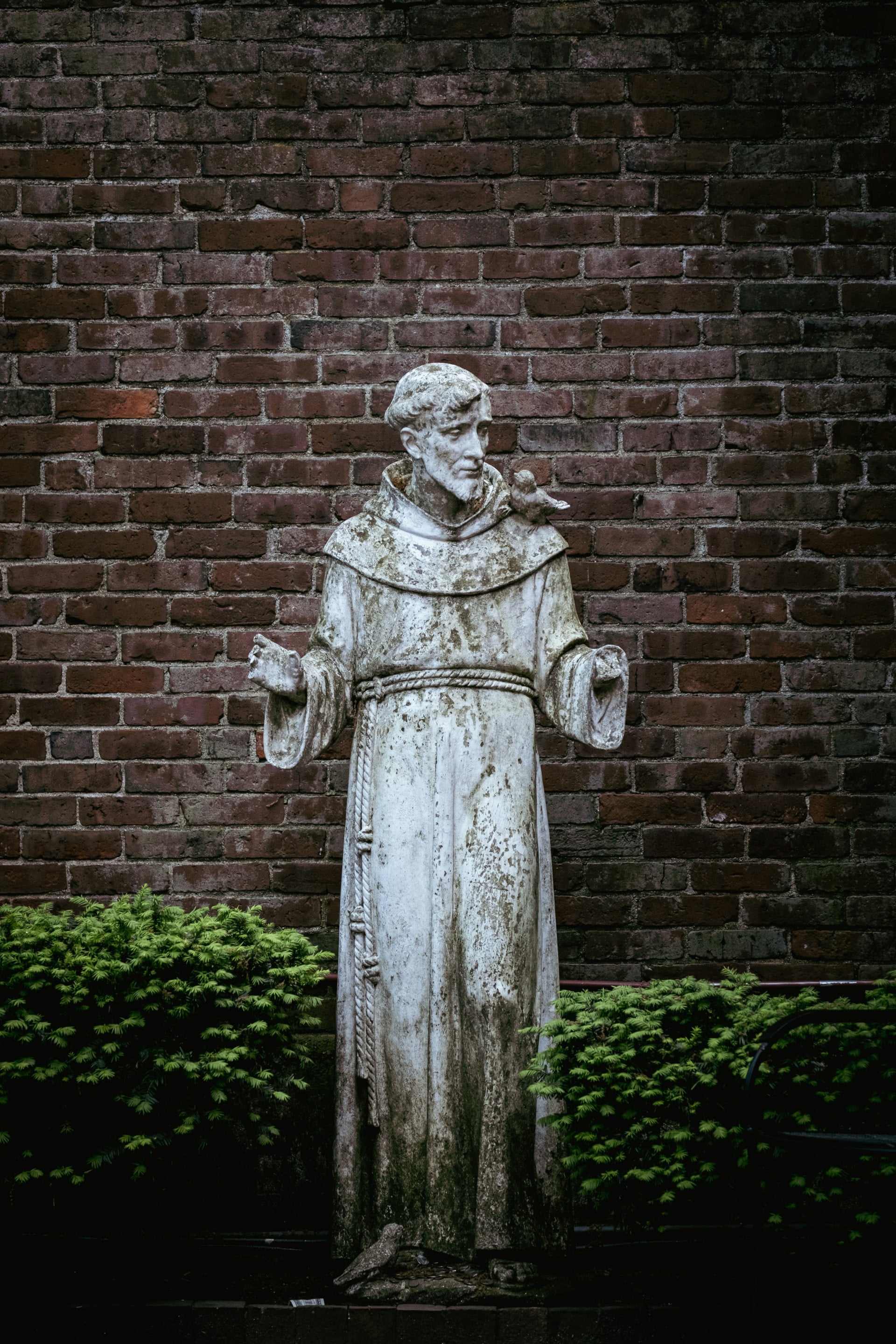
The image of birds flocking and flourishing in a modern day Eden goes hand in hand with images of St Francis.
We love the popular tales of St Francis: telling his brothers to keep going down the road whilst he stoped and preached to the birds.
Helping a village to befriend and feed a wolf, instead of living in terror.
Creating the first ever Christmas nativity scene to attract the villagers to worship at his little church outside Assisi.
And writing his famous poem The Canticle of the Sun, known best as the Hymn All Creatures of our God and King, where brother sun, sister moon, sister mother earth, and sister death all life their voices in praise to God.
These popular stories are well-know and well-loved, thanks to one of his brothers who collected together a volume called the ‘Little Flowers’ of Francis, and the biography of his life by St Bonaventure, commissioned by the Order in 1250, only 25 years after his death. In fact Francis has to be one of the best documented Saints of the medieval era and certainly one of the best loved, helped by the speed with which he was cannonised and made a Saint by the Pope within two years of his death.
But this romantic ideal of who he was, and the fact that he has been made the Patron Saint of both animals and the ecosystem, tend to eclipse the personal cost to Francis and the price he paid.
Possibly the most notorious story of Francis is his alienation from his family.
As a young man aged 26 he had left a career in the army in order to try and discern what God wanted for his life. Returning to his family home in the town of Assisi in Italy, his heart was moved by the beggars and lepers living on the outskirts of society. His father was a wealthy merchant and one day Francis took a considerable amount of fine cloth from his father’s warehouse, went to a neighbouring town, sold it, and tried to give away the money to the poor priest of a small village church, serving those who couldn’t afford to live in town. His father was furious and eventually Francis was summoned to the Bishop’s court, having refused to take notice of the town’s secular court.
Before any accusations were made, Francis “without a word peeled off his garments even removing his breeches and restored them to his father.” Completely naked, he said: “Until now I have called you my father on earth. But henceforth I can truly say: Our Father who art in heaven.” It is said that the astonished bishop covered Francis with his cloak, and Francis walked out of the city gates, in full public view, barefoot and alone, and lived in the woods above the city.
This kind of gesture is well-understood as the kind of thing a hot-blooded idealistic young person might do, and Francis staged it to perfection. The whole town witnessed it and witnessed his declaration of committment to the Gospel of the poverty of Christ.
Imagine the shame, the disgrace, the mortification and yes the heartache of his mother and father, once their anger had cooled. Not only had they severed relationships with their beloved son but they were now the recipients of sympathy and probably also gossip and laughter behind their backs. And Francis didn’t even have the decency to leave the district, but stayed and became a notorious and well-loved preacher in the villages.
Francis gained his integrity that day, but he also paid a price and lost the family he loved.
The trouble with being a champion of the poor and outcast is that some things have to die.
For Francis, those things included status and security.
What came to life was a rapidly growing movement of men and women who committed themselves to a life of service, simplicity, gentleness, compassion and the Way of Christ.
There is another story of Francis, one that sounds strange to our ears and difficult to make sense of. St Francis was the first person recorded in history to recieve the stigmata – the five marks or wounds made on Christ’s body at the crucifixion. Two years before his death he was praying, and had a vision of a seraph – an angelic creature – coming towards him from the sky, hanging on a cross, and bearing the wounds of Christ. When the vision disappeared he found that the marks had been transposed to his own body. It is said that he hid them from his companions and the event only became notorious at his death, when his body was examined.
Since Francis’s experience there have been about 300 recorded instances of devoted men and women recieving the stigmata, as a sign of their utter surrended to Christ and desire to be in union with him. What Paul writes of in his letter to the Galatians that we heard today – “I carry the marks of Jesus branded on my body” – has never been taken that St Paul had the stigmata but is taken as a reference to Paul’s other well-documented sufferings for the cause of Christ.
The trouble with being a Saint is that some things have to die, in order that other things might find life.
Today, not only the Franciscan Brother and Sisters continue to flourish, along with the Poor Clares, but also dozens of Anglican women and men here in Aotearoa New Zealand who are members of what is called the Third Order Franciscans – ordinary people, who haven’t taken vows to live in a religious community, but have taken vows to live a life of simplicity and compassion for all living things, alongside their daily life in the world.
All of us who follow the Way of Christ know that this will – or should – entail changes in our life style. For each of us there is a question that hangs in the air – how far am I willing to go for the sake of the Gospel of Christ? If I take a stand for compassion and justice – for human decency and kindness – what will the cost be? Will I run the risk of alienating friends and work companions and family?
I will never forget the outcry amongst my children and nieces and nephews the Christmas that I didn’t buy any trashy consumables, but bought each of them a voucher from a global Charity with the name of a goat or pair of ducks that had been bought with their voucher. At the time I grinned and said I wouldn’t repeat the gift the following Christmas – but the point was made and I’ve never bought trash again that will end up on the giant plastic waste piles across our planet.
What about you? If our lives became a little less cluttered – if some activities or purchases were allowed to die – what might come to life in their place?
If I took a deep breath – plucked up my courage – and spoke up when violence or cruelty or meanness is supported in the quest for a so-called ‘decent society’ – could I maintain my composure, knowing that the integrity of the Gospel is at stake?
One of St Francis’s most well-know prayers begins ‘Lord, make me an instrument of your peace’. Unfortunately there is no record that Francis himself ever authored it; the closest we can come is that it may be inspired by a prayer by Brother Giles, friend and companion of Francis. Be that as it may, it encapsulates much of the heart and soul of Franciscan spirituality and I end with it here.
Lord, make me an instrument of your peace.
Where there is hatred, let me bring love.
Where there is offence, let me bring pardon.
Where there is discord, let me bring union.
Where there is error, let me bring truth.
Where there is doubt, let me bring faith.
Where there is despair, let me bring hope.
Where there is darkness, let me bring your light.
Where there is sadness, let me bring joy.
O Lord, grant that I may not so much seek
to be consoled as to console,
to be understood as to understand,
to be loved as to love,
for it is in giving that one receives,
it is in self-forgetting that one finds,
it is in forgiving that one is forgiven,
it is in dying that one awakens to eternal life.
Francesco di Pietro di Bernardone, b. 1181; d. October 3rd 1226
https://www.liturgies.net/saints/francis/writings.htm The Writings of St Francis
https://www.britannica.com/biography/Saint-Francis-of-Assisi