By The Rev’d Jacky Sewell
The 1st Sunday of Creationtide
Readings: Luke 14: 25-33, Philemon 1:1-12, Jeremiah 18:1-11
The Potter and the Clay
A very dear friend of mine is very exceited at the moment. She’s just had her third kiln installed in her pottery studio, tucked down the bottom of her garden. Some years ago she made me this – it’s a Baptism jug, made for that purpose, though it does occasionally hold a profusion of flowers to brighten my kitchen bench.
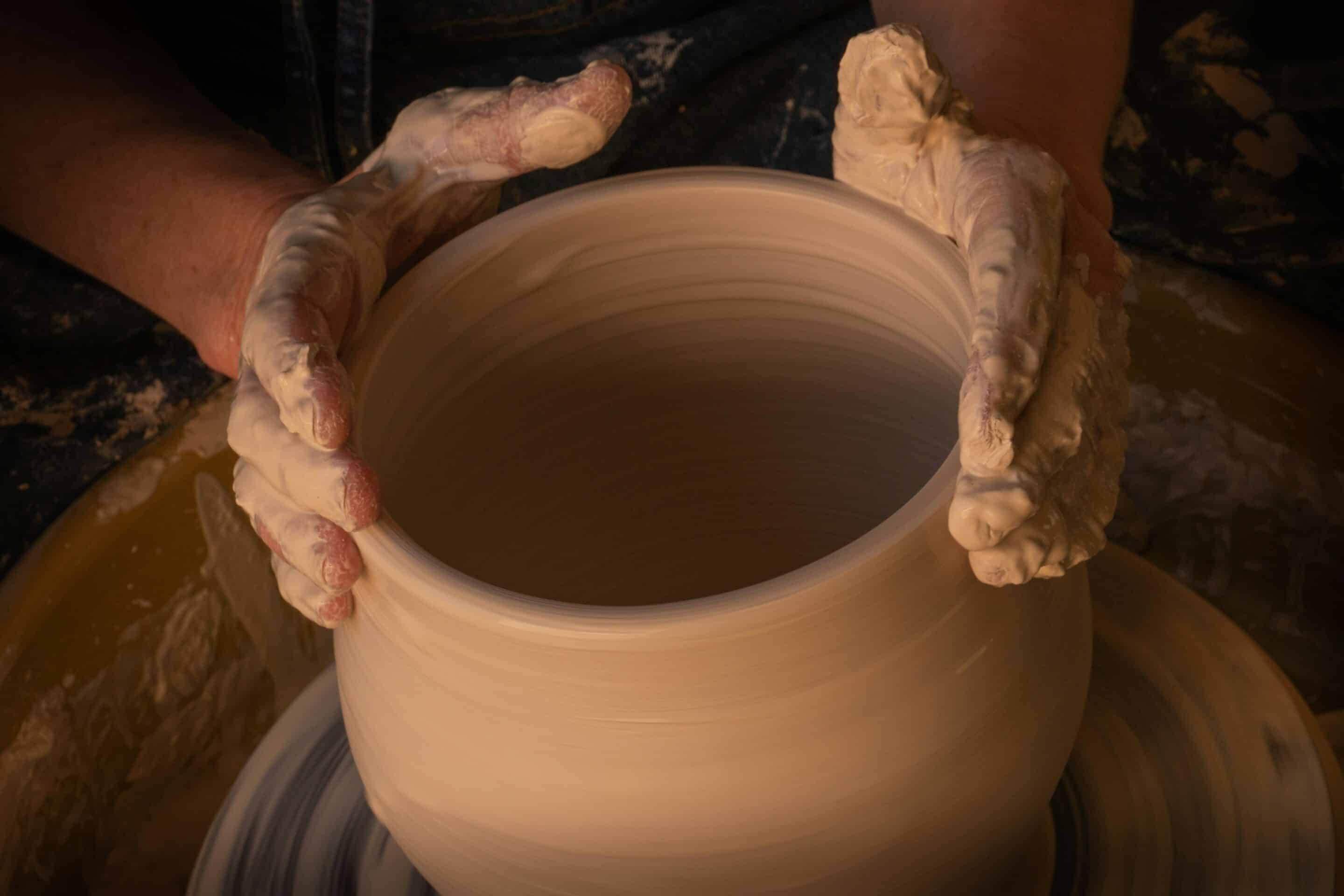
To make this jug, she started with a very fine white clay, made a sound, strong base, and then drew it up on her potter’s wheel, giving it a long neck, and then pinching out the spout with her finger and thumb. She then made a separate handle – I think this is a particularly fine handle – and pressed it onto the body of the jug. She then stamped the base of the jug and also here – at the base of the handle – with her signature stamp – a scallop shell – the symbol of a pilgrim. It tells people that it comes from her studio. Then she fired it for the first time.
Nothing is certain in the first firing. When the kiln has cooled, and can be opened, anything might be found. It might lie shattered on the bottom of the kiln especially if she cooled it too fast. It might have a crack through it – which for a Baptism jug would render it useless. The handle might have split and fallen off. Or it might emerge as she had hoped – intact, ready for the next stage.
This next stage takes the beauty of form and function, and adds another layer of colour and symbolism. Mel chose a particular green glaze which complements the usual blue for water symbolism. She had already had a prayerful vision of the outside of this jug and she expresses it in the words painted around the base – “I saw Water, Alleluia, Alleluia”. It’s the cry of Ezekiel as he sees the throne of God and the rivers of water flowing from the temple – and image of abundant life echoed in the book of Revelations.
The waters swirl around the jug, and three tiny boats are caught up on the waves each with tiny figures in it. These tiny boats carry many layers of symbolism: They are the symbol of the ecumenical church universal and an ancient Christian symbol of salvation. The remind us of Jesus and his friends on Lake Galilee and the times Jesus calmed the storm, or hauled Peter from drowning, or fed his friends on the beach at dawn after his resurrection.
Once Mel had painted these things, the whole Baptism jug went back into her kiln for it’s second firing. This is alchemy! The finished colour might be completely different, and no two glaze firings produce the same result. The potter can only stand back in awe, as the fire and clay and chemicals and oxygen do their work.
Vessels Holding the Holy
Mel’s Baptism jug is here with me today, not just as a cutesie demonstration of Jeremiah’s vision, but as a vessel, made of the elements of creation, that holds sacramental potential for us at the start of Creationtide.
For the purposes of Baptism, it will hold ordinary water that becomes super-ordinary water – water that has been transformed into a means of grace for the Sacrament of Baptism.
Let’s just quickly refresh our knowledge of Sacramental theology, because this, I believe, is critical for our understanding of creation and this season of Creationtide.
A Sacrament holds the ancient definition of an outer and visible means of an inner and invisible grace. St Augustine came up with this in the 5th century and it has held fast through centuries of upheaval of Catholic and Protestant theology and understanding.
So water – ordinary water – becomes through prayer and intention an outer and visible means of the inner and invisible grace of becoming one with Christ through Baptism. It is more than just a symbol – though I hold it true that it also represents the innate sacredness and sacramentalism of all the waters of creation. But it is more than just a symbol – as a sacrament, it performs something. It becomes the means of grace. It makes visible what God has always held to be true – that we are God’s children, a part of God’s creation, blessed by God in order that we may flourish and in order that the whole creation might be brought back into alignment with God’s purposes.
The other sacrament – the second sacrament of the Anglican communion – is of course the Eucharist. Ordinary bread and wine, representatives of God’s abundance creation, becoming supra-ordinary. An outer and visible means of the inner and invisible grace that is Christ’s outpouring of love, so that we might be nourished, fed, and enabled to pour out that same love to others.
The church holds to these two Sacraments as they were seen in the life and ministry of Jesus. Other acts of ministry are also moments of grace – the lesser ‘sacraments’ of marriage, annointing, confirmation, reconciliation and ordination.
The Sacredness of Creation
However there is another way in which we use the word sacrament – and that’s as an adjective – sacramental.
Remember that I said Mel’s Baptism jug is here with me today as a vessel, made of the elements of creation, that holds sacramental potential for us at the start of Creationtide? And that the waters of Baptism represent the innate sacredness and sacramentalism of all the waters of creation?
This way of thinking – that the whole created order bears the imprint of God’s hand and is, of itself, ‘holy’, is very common nowadays but can’t be taken for granted.
The church has always held in tension two ways of thinking. One is that God’s Holy Spirit infuses the whole created order. Our task is to bring our lives back to awareness of God, and our actions back into alignment with God’s Spirit, forever yearning within us.
The other way of thinking is that creation is devoid of God’s holiness and God’s Spirit, and only through the grace of Christ can it be redeemed. In another time and another sermon we might explore how our thinking about original sin has psychologically placed us as empty vessels, devoid of goodness and of God.
So is creation empty of Spirit, or infused with Spirit? If we did a quick show of hands – and I’m not going to do that – I’m sure we would find a diversity in this room and and good number of us who hover somewhere in between.
Personally, I find I am continually being surprised – and sometimes ambushed – with the radiance of God and goodness throughout humanity and the whole created order.
It is my relationship to creation, and my attitude to others, that can more often be the issue.
In my baptism, when just a babe, I became part of a people who believed that we have the capacity to see holiness, and become part of that holiness, even if I too often fall short.
The Gospel Witness
We started this sermon as clay in the hands of Jeremiah’s potter; clay that is able to be reworked and repurposed, if its flaws become apparent.
Paul’s letter to Philemon gave us a startling example of how the early church was forced to reconsider that way it viewed other human beings; how existing relationships needed to be deconstructed and then reconstructed.
A brief precis: Philemon is a powerful and influential Christian of the early church, who had a slave, Onesimus. Through some cause he displeased Philemon and was dismissed from the household – though still by law a slave, owned by his master. Somehow he ends up in Rome where Paul is under house arrest, and Paul ‘adopts’ him into his household. Paul then writes to Philemon and presents him with a challenge: can you, in the name of Christ, release him from legal bondage and receive him as a brother, as an equal?
The tone of the letter leave us the reader in no doubt that Paul knows Philemon will be furious: this re-defining of slaves as equals is a huge issue and will require a lot of soul-searching.
But Philemon, like Onesimus, has been baptised, and has become part of a people who believe that we have the capacity to see holiness in others. That we are God’s children, a part of God’s creation, blessed by God in order that we may flourish and in order that the whole creation might be brought back into alignment with God’s purposes, not just existing to serve my happiness.
Jesus in today’s Gospel said something similar, and in even more contentious language than Paul. Do you want to call yourself my disciple? Well then be prepare to overhaul your relationships with family, with how you view the world, with how you view all your possession and even with life itself.
The Good News is that we are as clay in the potter’s hand; we can be repurposed, reworked, realigned. We do have the Spirit at work within us and at work within the whole of creation, and we as human beings can pick ourselves up, shake ourselves off, and treat the rest of God’s good creation with the respect it deserves. The days of treating the rest of creation as if it existed only to serve my happiness have passed. My challenge is to live out my baptism with courage and faith.
Amen.